Deadwood removal
Dead and dying limbs are the first to fall in a storm. Clearing them lowers the immediate hazard and lets you see the tree's real structure.
Tree trimming and pruning near Lincoln, NE: how to spot overgrown or storm-prone limbs, what good pruning does, and how our climate shapes the right timing.
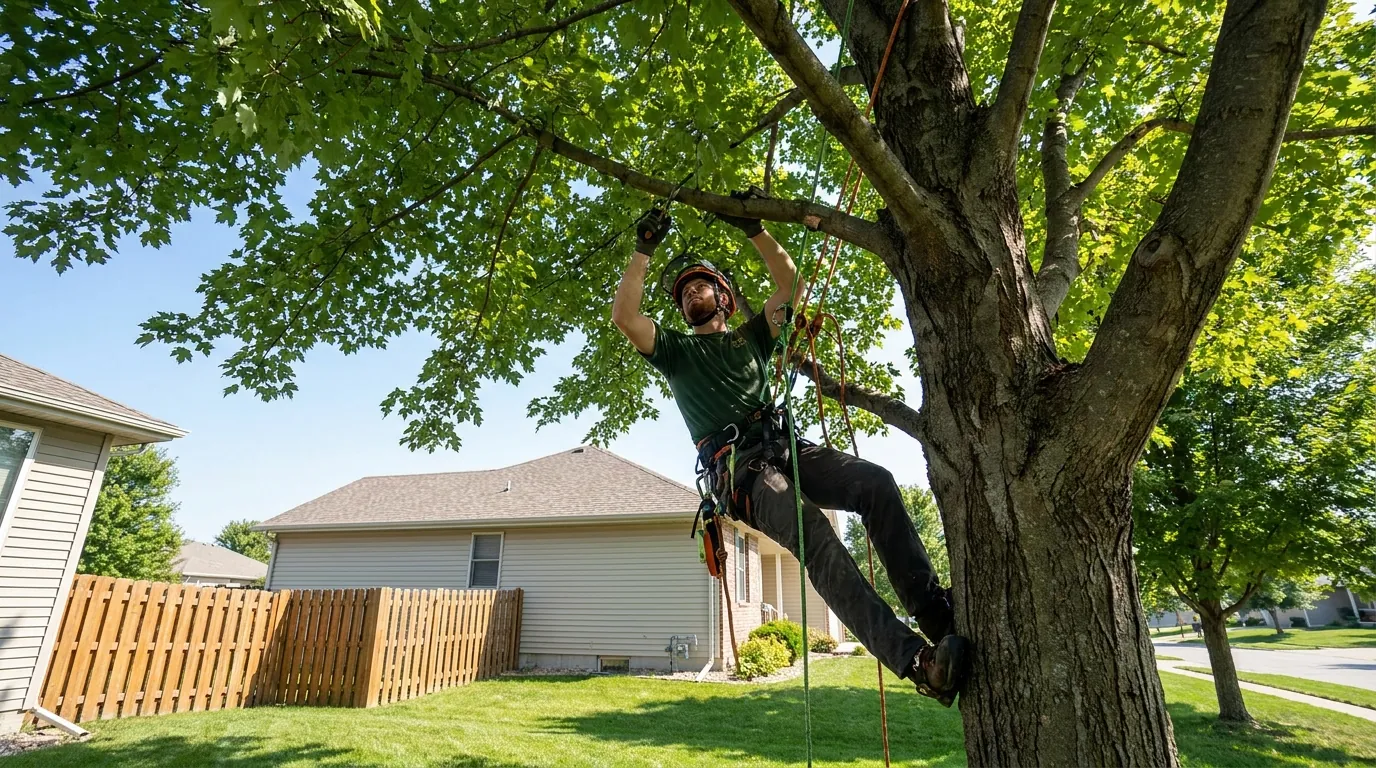
Good tree trimming is less about shaping a tree and more about managing weight, structure, and risk. In Lincoln, where spring storms deliver straight-line winds and wet, heavy snow comes early and late, a tree with crowded or poorly attached limbs is a tree waiting to drop one. The warning signs homeowners notice are branches scraping the roof, limbs growing back toward the house, deadwood collecting in the canopy, and whole sections that didn't leaf out this spring.
Many of the fast-growing species common here — silver maple and Siberian elm especially — form weak, V-shaped unions that split under load. Thoughtful pruning removes the deadwood, reduces end weight on heavy limbs, and improves the branch structure so the tree carries wind and ice better. Done at the right stage, trimming can keep a tree out of the removal conversation entirely; left too long, the same tree becomes a candidate for tree removal.
Trimming is also where a lot of hidden decay first shows up. If a crew finds cavities, extensive deadwood, or fungal conks while working the canopy, that's worth a closer tree health assessment before deciding how aggressively to prune.
Pruning is matched to the tree and the goal — never just a uniform haircut.
Dead and dying limbs are the first to fall in a storm. Clearing them lowers the immediate hazard and lets you see the tree's real structure.
Selective cuts reduce end weight on long, heavy limbs so they flex less and break less in Lincoln's wind and ice events.
Limbs are pulled back off roofs, gutters, driveways and power drops to stop rubbing damage and keep sightlines clear.
Early cuts on a young tree set a strong branch framework, correcting the weak unions that cause splits decades later.
Point out the limbs over the roof or the branches that didn't leaf out, and we'll recommend what to prune and when.
Trimming and pruning for Lincoln and the surrounding communities.
Late winter through early spring, before leaf-out, is ideal for most species because the structure is visible and the tree heals as it wakes up. Storm damage and clearly dead limbs, though, can be removed any time of year without harm.
As a rule, removing much more than a quarter of a healthy canopy in one season stresses the tree. Over-thinning forces weak, bushy regrowth, so good trimming is restrained and spread across visits when a lot needs doing.
Reducing deadwood and end weight meaningfully lowers the odds of limb failure, especially on weak-unioned maples and elms. No pruning makes a tree storm-proof, but a well-structured canopy handles Lincoln wind and ice far better than a neglected one.
No. Topping removes the upper canopy indiscriminately and triggers a flush of weak, poorly attached shoots that are more dangerous than what was cut. Proper reduction cuts back to healthy lateral branches instead.