Brush and undergrowth
Dense shrubs, invasive honeysuckle, and volunteer saplings are cut and removed to open up the ground and restore access along fences, drives, and property lines.
Clearing an overgrown lot or brush line near Lincoln, NE? Learn what the work involves, how loess soil affects it, and how to plan the job.
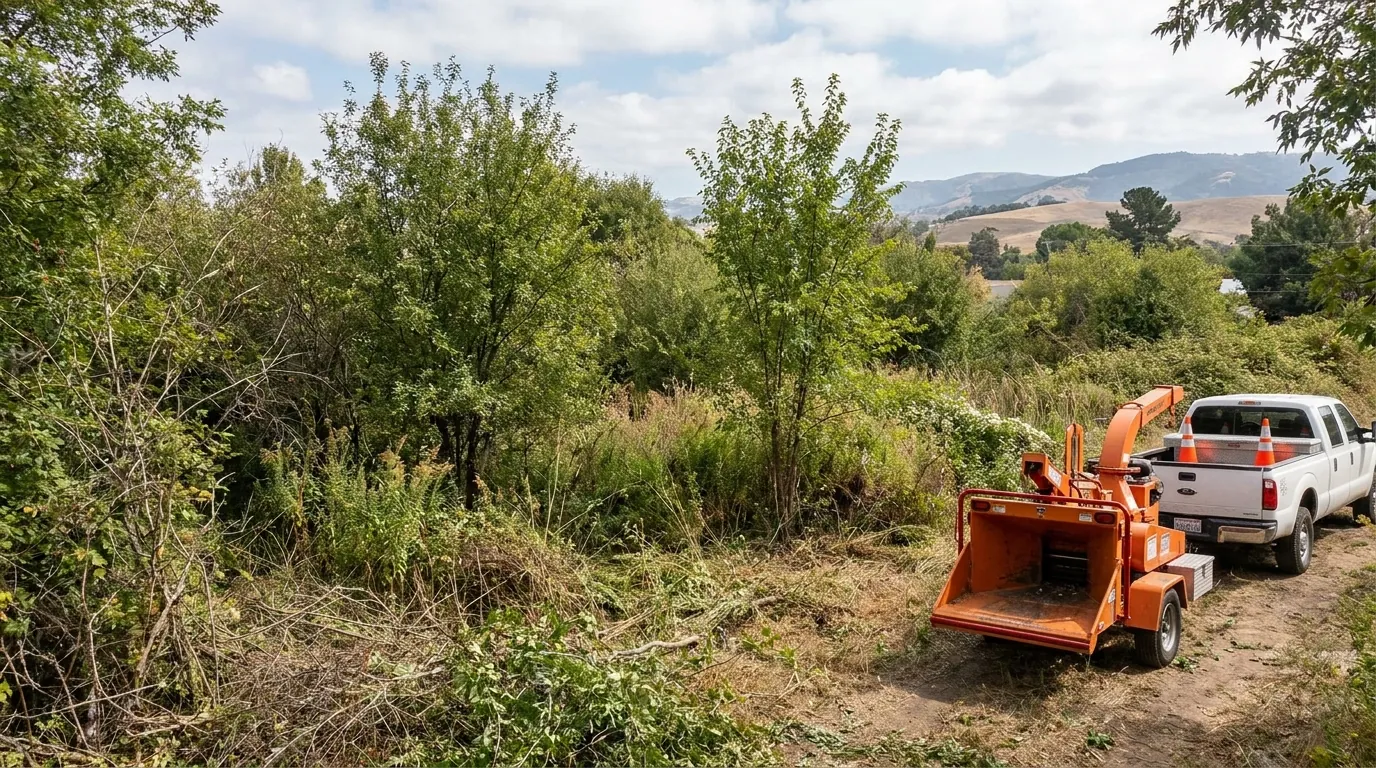
Open ground in and around Lincoln doesn't stay open on its own. Give a fence line, a creek edge, or a vacant lot a few seasons and it fills with volunteer mulberry, Siberian elm, honeysuckle, and a tangle of brush that crowds out everything else. Lot and brush clearing is the work of taking that back to usable ground — whether you're prepping to build, opening up a sightline, reducing fire and pest habitat near the house, or just reclaiming a corner of the yard.
Clearing is different from removing a single tree. It's about handling a mix of sizes and species across an area, deciding what stays and what goes, and leaving the soil in a condition you can actually use afterward. A good clearing plan protects the trees worth keeping and the ground you'll later plant, pave, or build on. Where a single large specimen is involved, that's handled as a tree removal within the larger job.
A clearing job usually blends several kinds of work depending on what's grown in.
Dense shrubs, invasive honeysuckle, and volunteer saplings are cut and removed to open up the ground and restore access along fences, drives, and property lines.
Volunteer elms, mulberries, and crowded trees that have no long-term place on the lot are taken down and processed, with the usable material separated from the debris.
Not every lot should be stripped bare. Trees worth keeping for shade, screening, or value are marked and protected while the surrounding growth is cleared around them.
Cut material is chipped or hauled, and remaining stumps can be ground down so the area is ready for the next use rather than left as a trip hazard.
Clearing works best as a planned sequence rather than an all-at-once bulldoze.
First we look at what's there and what you want the ground for — building pad, garden, pasture edge, or clean sightline. That goal decides how much comes out and what stays.
Trees and features worth preserving are flagged, along with property lines, utilities, and anything underground, so the clearing stays within bounds.
Brush and unwanted trees are taken down in a logical order, with material chipped or hauled as the work moves across the area.
Remaining stumps are ground and the surface is left clear and reasonably even, ready for whatever comes next on the site.
The loess soils around Lincoln hold moisture unevenly and are prone to erosion once vegetation is stripped, so smart clearing leaves enough root structure or cover on slopes and creek edges to keep the ground from washing after spring storms. Timing matters too: the freeze-thaw cycle means equipment can rut soft ground in late winter and early spring, while late summer and fall usually give firmer footing and less mud. We factor that into when and how a lot is cleared.
Clearing often reveals a tree or two worth saving — and those are worth a closer look with a tree health assessment before you invest in landscaping around them. If you've got a lot, a fence line, or a brushed-in corner you want opened up anywhere in the Lincoln area, reach out and describe the size of the area and what you plan to do with it, and we'll walk you through the approach.
Either way. Most clearing jobs are selective — we flag the trees worth keeping for shade, screening, or value and clear around them. If you need the whole area taken to bare ground for a build, that's handled too.
Cut material is typically chipped on site or hauled away, depending on the volume and what you'd like done with it. Usable wood can often be set aside, and chips can be left as mulch if you want them.
Late summer and fall usually offer firmer, drier ground, which means less rutting and cleaner access. Early spring can be muddy after the thaw. We plan around soil conditions to protect the site you're keeping.
It can if ground is stripped bare on a slope or near water, which is why clearing near Lincoln's erosion-prone loess soils is done with cover and grade in mind. We leave enough structure to hold the soil through spring runoff where that's a concern.
Call to describe the problem and get a quote for work in Lincoln, NE.