Tree Removal — Cost, Process and Scheduling in Lincoln, NE
Tree removal near Lincoln, NE: warning signs a tree should come down, how the work is done safely on tight lots, and what drives the cost on loess soil.
When tree removal is the right call
Not every troubled tree needs to come down, but some do — and in Lincoln the decision usually turns on structure and location, not just appearance. A silver maple with a split trunk union hanging over a bedroom is a different problem than a dead ash at the back of an acreage. Tree removal near me searches tend to spike after our spring storms, when homeowners finally see the cracks and lean that were building for years.
Lincoln's older neighborhoods are full of fast-growing species — silver maple, Siberian elm, cottonwood — planted decades ago and now oversized for the lots they stand on. Add emerald ash borer, which has hollowed out ash across Lancaster County, and a large share of removals here are about trees that are already failing from the inside. The warning signs worth acting on include a sudden lean, mushroom conks at the base, large dead limbs in the upper canopy, bark falling away in sheets, and soil heaving on one side of the root plate.
If you are not sure whether a tree is a true hazard, a tree health assessment is the honest first step — sometimes the answer is targeted tree trimming rather than removal. When removal is warranted, the goal is to take the tree down in a controlled way that protects the house, the fence, the neighbor's yard, and the people on the ground.
How a Lincoln tree removal is done
Every job is planned around the tree's condition and what sits beneath it. A typical removal moves through these stages.
-
Assessment and plan
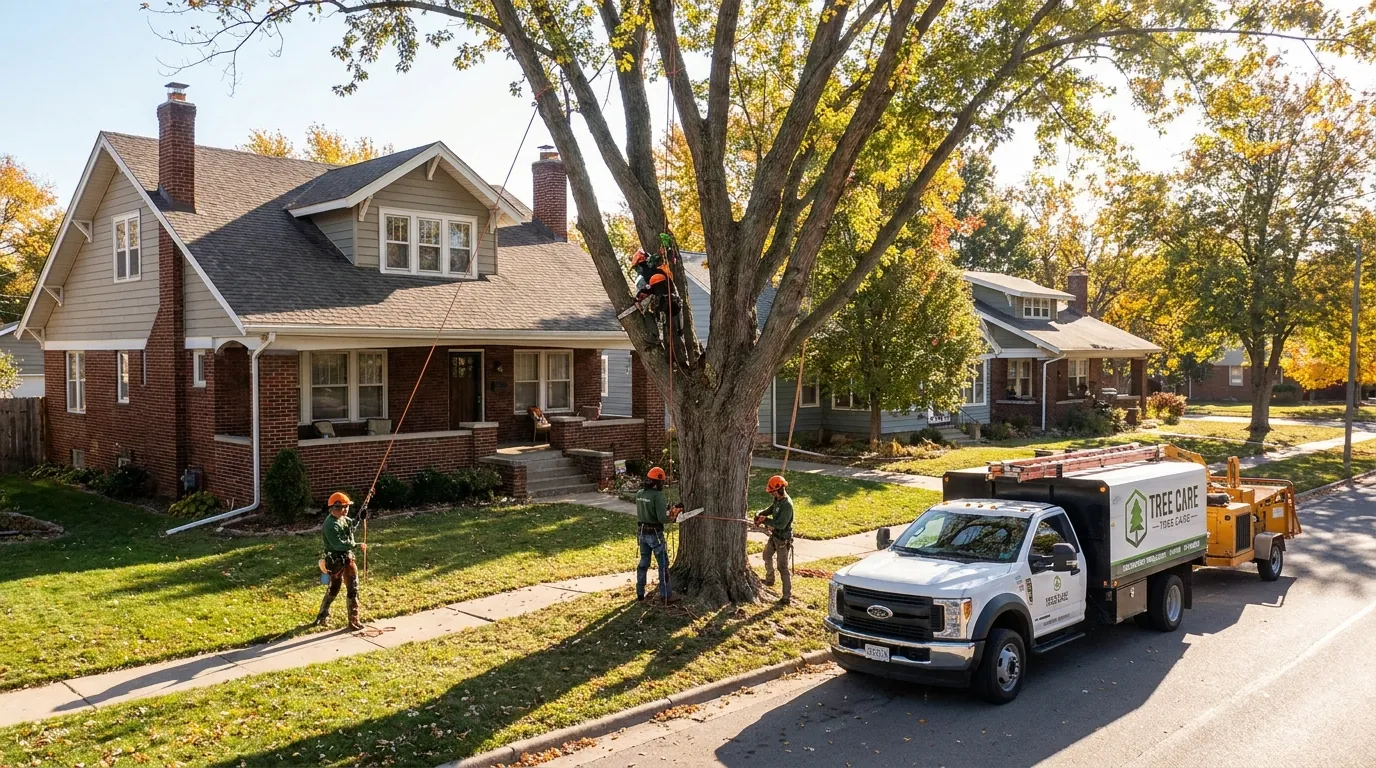
We walk the site, judge lean, decay and canopy weight, and identify targets — roof, power drop, fence, garden beds. On a tight city lot the plan is usually to climb or use a lift and lower sections by rope rather than fell the whole tree.
-
Setting up a safe drop zone
Ground is protected, vehicles are moved, and a clear work area is established. Loess soil softens fast after rain, so timing and ground protection matter when heavier equipment is involved.
-
Sectional takedown
Limbs and trunk are removed in managed pieces, lowered or dropped into the cleared zone. Dead and borer-weakened wood is handled with extra care because it breaks unpredictably.
-
Processing and cleanup
Brush is chipped, logs are cut to length or hauled, and the work area is raked clean. What remains is the stump, which is addressed separately.
-
Stump decision
You choose whether to leave the stump or have it ground below grade. Most homeowners pair removal with [stump grinding](/services/stump-grinding/) so the area can be replanted or mowed.
Get a plan for your tree
Tell us what you're seeing — the lean, the dead limbs, the tree over the garage — and we'll walk the site and lay out your options.
Serving Lincoln and nearby towns including Waverly, Hickman and Bennet.
Frequently asked questions
What drives the cost of removing a tree in Lincoln?
The biggest factors are size, lean, and what sits under the canopy. A tall tree over a roof or power line that must be climbed and lowered piece by piece takes far longer than one that can be felled in an open yard, and access for chipping and hauling also moves the price.
Do I need to remove a tree with emerald ash borer?
A dead or dying ash becomes brittle and dangerous quickly once the borer has run its course, so removal is usually the safer call. If the ash is still largely healthy, a treatment and monitoring plan may buy time, which is worth discussing during a site visit.
How soon can a dangerous tree be taken down?
Trees posing an immediate threat to a home or people are prioritized, and our emergency tree service handles failures that can't wait. Standard removals are scheduled based on crew availability and ground conditions after rain.
Will removal damage my lawn?
On the saturated loess soils common here, heavier equipment can rut a wet yard, so we protect the ground and sometimes wait for firmer conditions. Rope-lowering and careful drop zones keep most of the surrounding lawn intact.