Tree removal
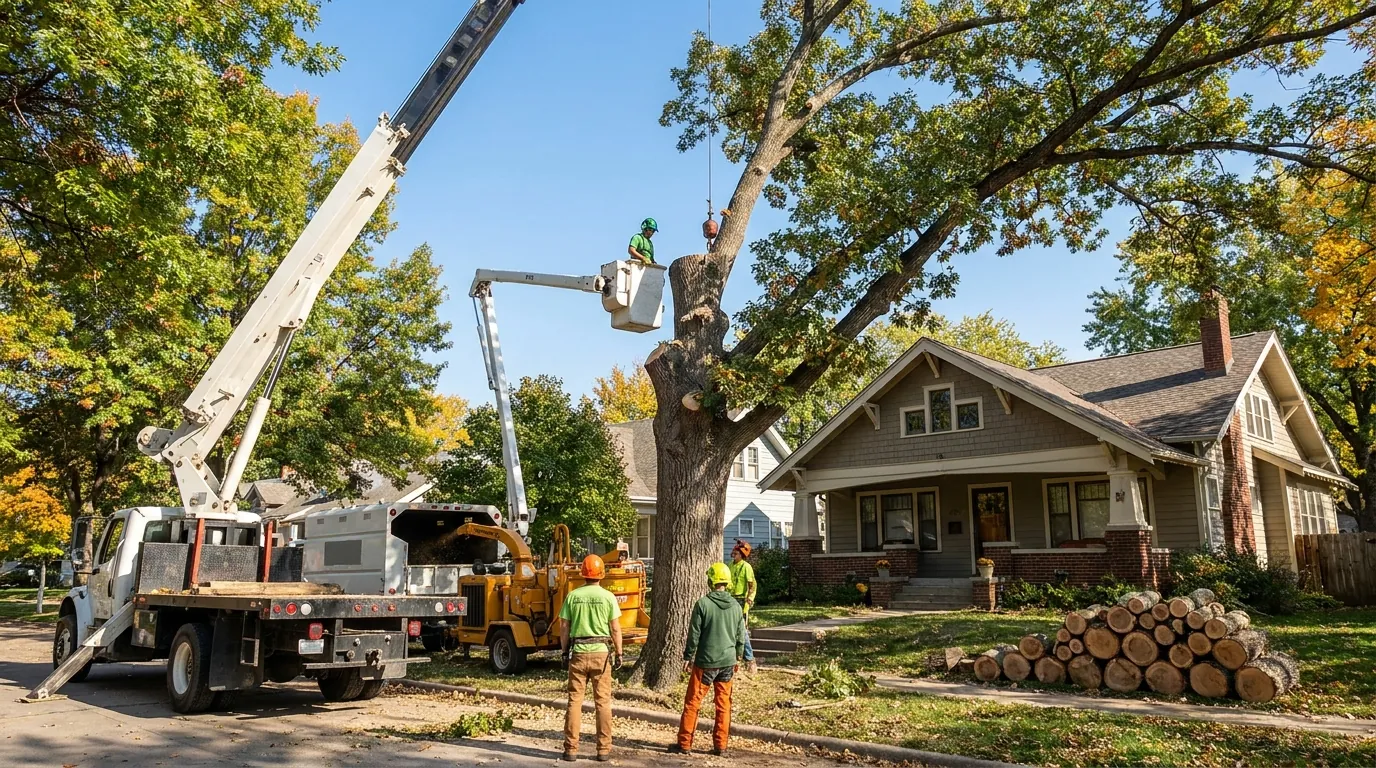
Full removal of dead, dying, hazardous or unwanted trees, including rigging-down work in tight Lincoln yards where a tree can't simply be felled.
Lincoln Tree Solutions
Removal, trimming, stump grinding and storm cleanup for Lincoln and the surrounding towns.
Serving Lincoln, NE and the surrounding area.
Lincoln sits on deep loess soil, gets long hard winters with repeated freeze-thaw swings, and takes a regular beating from spring and summer storms rolling in off the plains. All three of those things decide how trees here grow, how they fail, and when taking one down is the safer choice. A silver maple that looks fine in July can shed a limb over a driveway after one wet, windy night in May. An ash with thinning upper canopy may already be failing from the inside. Lincoln Tree Solutions exists to help homeowners read those signs early and act before a problem becomes an emergency.
This site is for homeowners and property owners in Lincoln and the nearby communities who have a tree that worries them — one leaning toward the house, one that dropped a major limb, one that died back over a hard winter, or a lot that has grown over with brush. We handle the full range: careful removals in tight yards, routine tree trimming to keep canopies sound, stump grinding after a tree comes out, and emergency tree service when a storm leaves something hanging.
The goal on every job is the same: understand the tree and the site first, then do the least invasive work that solves the problem. Sometimes that is a full tree removal. Often it is selective pruning, cabling decisions, or simply a plan to watch a tree through another season. A tree health assessment is where many of these jobs start.
Lincoln's loess soil is fine, wind-deposited silt. It holds moisture and roots well in a normal year, but it also slumps and loses grip when it gets saturated. After a soaking spring rain, a tall tree with a shallow or one-sided root plate can start to tip — and loess won't hold it the way heavier clay might. That is why leaning becomes dangerous fast here after wet weather, and why we look hard at the soil heave and root flare around the base of any tree being assessed.
The freeze-thaw cycle is the second factor. Water gets into bark cracks, old pruning wounds and frost cracks, freezes, expands, and works the opening wider over successive nights. Over several winters that is how a seam of internal decay forms in otherwise healthy-looking trees. Species common to this part of Nebraska — silver and Norway maple, green ash, hackberry, cottonwood — each respond differently, and ash in particular has been hit hard regionally, leaving brittle standing deadwood that fails without warning.
The third factor is Lincoln's storm season. Straight-line winds, hail and the occasional heavier event stress trees that are already compromised. A tree that survived with hidden decay or a weak branch union is exactly the one that drops a limb in a 60 mph gust. Timing matters: we would rather reduce a risky canopy in the calm of fall or late winter than meet it as a downed tree over your garage in June.
Six core services covering the life of a tree, from assessment to the ground-level stump.
Full removal of dead, dying, hazardous or unwanted trees, including rigging-down work in tight Lincoln yards where a tree can't simply be felled.
Structural and clearance pruning to reduce storm risk, lift canopies off roofs, and keep maples, oaks and ash in better long-term shape.
Grinding stumps below grade after removal so you can reclaim the space, replant, or keep a clean lawn line.
Response to storm-damaged trees — broken limbs, split trunks, and trees down on structures or blocking access.
Clearing overgrown fence lines, acreage edges and buildable lots of brush, saplings and tangled undergrowth.
A ground-up look at a tree's condition — decay, lean, root issues, canopy dieback — so you can decide whether to treat, prune or remove.
Practical answers to the questions we hear most in Lincoln, NE.
A practical guide to hiring a tree removal contractor in Lincoln, NE — what to ask, how estimates work, and the red flags to avoid before work starts.
A step-by-step look at how tree removal actually happens in Lincoln, NE — from assessment and rigging to felling, stump grinding, and cleanup.
How to tell when a Lincoln tree should be removed — the warning signs of decay, lean, and storm damage, and when trimming is enough instead.
Not always. A single broken limb on an otherwise sound tree can often be cleaned up with proper pruning cuts. Removal becomes the right call when the trunk is split, a major union has failed, or a tree is leaning in saturated soil. An assessment tells you which situation you have.
Lincoln's loess soil loosens its grip on roots when it gets waterlogged, so leaning trees turn dangerous quickly after heavy spring rain. Repeated freeze-thaw cycles also open internal decay in trees that look healthy on the outside. Both change how urgently a tree should be addressed.
Yes. When there isn't room to fell a tree in one piece, it's rigged down in sections and lowered in a controlled way to protect fences, roofs and gardens. This is common on Lincoln's older in-town lots where houses and trees sit close together.
Removal and stump grinding are separate steps, and you can choose either or both. Many homeowners have the stump ground below grade so they can replant or restore the lawn, while others leave it for a season. We'll quote them as line items so you can decide.
Alongside Lincoln we work in Yankee Hill, Walton, Emerald, Waverly, Bennet and Hickman, including rural acreages around those communities where lot and brush clearing is common.
Tell us what you're seeing — a lean, a dropped limb, dieback, or a lot that needs clearing — and we'll talk through the options, from pruning to full removal. Start with a tree health assessment if you're not sure.
Serving Lincoln, NE and nearby towns.