Dieback in the canopy
Bare branches at the top or edge of the crown, or leaves that come out late and thin, often mean the tree is losing the fight below ground — a root or vascular problem that an assessment can pin down.
Worried about a tree in your Lincoln, NE yard? A tree health assessment reads the signs, weighs the risk, and tells you whether to treat, trim, or remove.
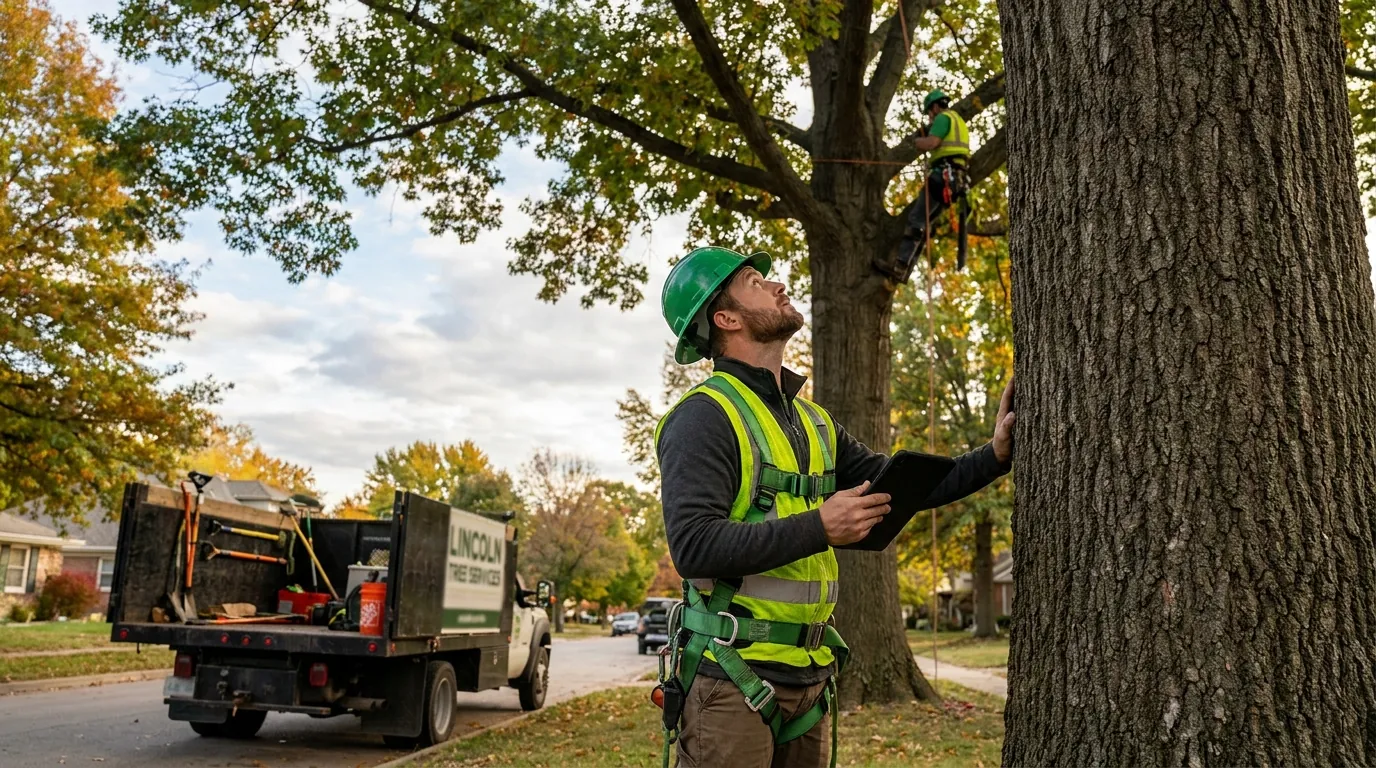
Most homeowners call about a tree because something changed — dead branches at the top, mushrooms at the base, a crack in the trunk, or a lean that seems new. A tree health assessment answers the question behind all of those: is this tree safe and worth keeping, and if not, what should happen instead? It's the step that keeps you from either removing a tree that just needed a trim, or keeping one that's about to fail.
An assessment looks at the whole tree — roots, trunk, branch structure, and canopy — and reads them against the species, the site, and Lincoln's conditions. The point isn't a vague opinion; it's a clear recommendation: treat it, prune it, monitor it, or remove it. If the answer is pruning, that's a job for tree trimming; if the structure has failed, it leads to tree removal.
Any of these is a good reason to get a tree assessed before a storm decides for you.
Bare branches at the top or edge of the crown, or leaves that come out late and thin, often mean the tree is losing the fight below ground — a root or vascular problem that an assessment can pin down.
Mushrooms or conks at the base or on the trunk, and wood that sounds hollow or crumbles, point to internal decay that can quietly undermine a tree's strength.
Vertical cracks, open cavities, or tight V-shaped forks with bark pinched inside (included bark) are structural weak points that tend to fail under Lincoln wind and ice.
A lean paired with cracked or raised soil on one side of the trunk suggests the root plate is moving — one of the more serious signs an assessment is meant to catch early.
A thorough look follows the tree from the ground up.
The root flare, surrounding soil, and base of the trunk are checked for decay, girdling roots, heaving, and fungal bodies — problems that are hidden but decisive.
The trunk and major stems are examined for cracks, cavities, dead bark, and weak unions, which reveal how well the tree can carry its own load in a storm.
The crown is assessed for deadwood, dieback, broken or hanging limbs, and overall vigor, which together show how the tree is faring.
The findings are weighed against the target below the tree — house, driveway, play area — to produce a clear call: treat, prune, monitor, or remove, with reasons.
The same tree can be a keeper in one yard and a hazard in another, and Lincoln's conditions push the odds. Freeze-thaw cycles stress bark and open cracks wider each winter; loess soils can hold water around roots and then dry and shrink, encouraging decay and root loss; and spring and summer storms deliver the wind and ice loads that find every weak union. Native and common species behave differently under that stress — a cottonwood, a silver maple, and an oak each fail in their own way, and an assessment reads for the right ones.
Getting a tree looked at before storm season is far cheaper and safer than after a failure. If an assessment shows a tree is beyond saving, the natural next steps are tree removal and, afterward, stump grinding to finish the job. Tell us which tree is worrying you and what's near it, and we'll take a proper look before anything is decided.
Sometimes. A tree can tolerate a surprising amount of decay if enough sound wood remains and there's nothing valuable below it to hit. The assessment weighs how much strength is left against what the tree could damage if it failed.
A quote assumes you've already decided what to do. An assessment comes first — it reads the tree's actual condition and risk and tells you whether removal is even the right answer, or whether pruning or monitoring would serve you better.
Before Lincoln's spring and summer storm season is ideal, because that's when weak trees get tested. Winter, with leaves down, also makes structural defects in the branches easier to see.
Then the recommendation is usually pruning rather than removal. Thinning and structural trimming can reduce storm risk and improve the tree's long-term health without taking it out.
Call to describe the problem and get a quote for work in Lincoln, NE.